
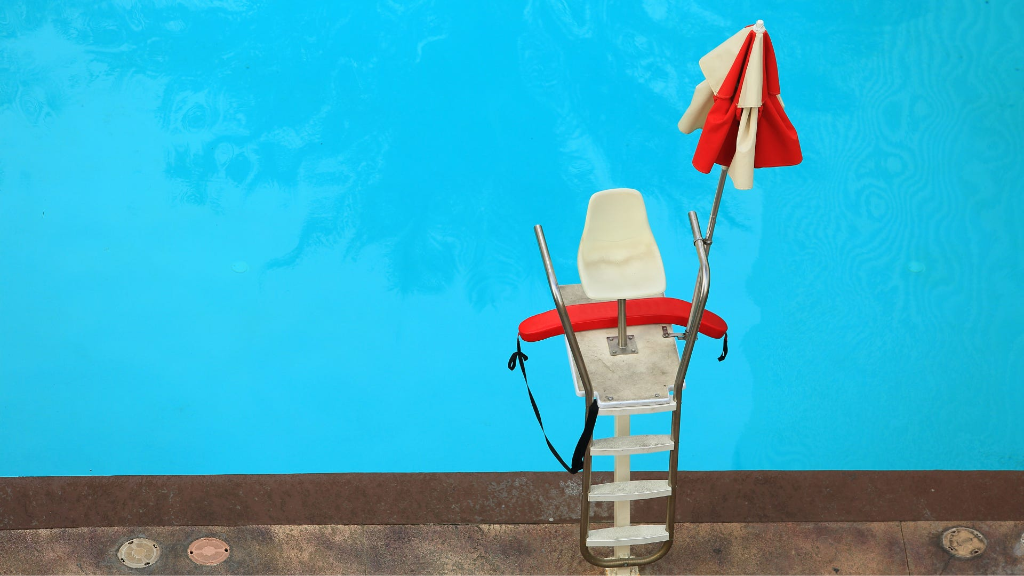
“It’s gonna pass,” Sarah told him.
Aiden stared at the weather app on his phone. “Says rain until ten.”
“It’ll pass.”
“Wanna bet?”
“Sure.” She swiveled in her chair, elbow propped on the front desk. Aiden wondered how it was possible to be so casually beautiful. Maybe scientists were studying it right now. “If we don’t reopen, I’ll close for you all next week.”
“Deal.”
They shook.
Thunder rumbled in the distance, restarting the thirty-minute wait clock. 5:45pm. Aiden would need a few more of those to close out the day.
Which he got, easily. By eight, all but one dedicated patron had vacated the parking lot: Lawn Chair. Not her real name (it was Karen, if you can believe it), but to Fanny staff it was, and always would be Lawn Chair. Nobody remembered when exactly she’d earned this nickname, but everyone knew how: after an A.M. thunder storm, Karen had pulled a lawn chair from her trunk and parked it under the front entrance awning to wait out the weather closure—for seven hours. And that’s how legends were made.
The huddle of guards in the breezeway had dwindled, each leaving as their phones died or evening plans materialized. Kate, the assistant manager, was weeding the playground despite the light rain (Aiden wasn’t sure if that was just a mom thing, or an almost-forty thing) which left him and Sarah up front. He grabbed a Diet Coke from the fridge. Cracking the can wasn’t meant as a victory move, but it sounded like one when he followed it with, “So.”
“Don’t rub it in.”
“Probably you should start thinking about packing dinners.”
“There’s still time.”
Aiden sat in the front office’s other swivel chair. Sarah’s biology textbook took up most of the desk between them—a metaphor, as it were, being that med school was apparently the reason (her reason) that they were no longer together.
“Still here, ha.” Lawn Chair popped into view. She knew better than to step across the sacred plastic chain strung holding up a CLOSED sign strung between orange cones. “My weather app says it’s gonna pass.”
“Maybe,” Sarah said. No sarcasm, no biting irony, even though everybody knew—even Lawn Chair must know—that she deserved it sometimes. Of the many things he’d loved about Sarah (no, present tense, just loved), her genuine lack of maliciousness ranked near the top. “Aiden can guard, if it does.”
“I can,” he confirmed.
“Great.” Lawn Chair gave them two thumbs up. “Perfect. See you in—” she checked her watch—"Twenty-one minutes.”
Still here.
Yes: Aiden was still a student manager at Fanny. He was well aware that some people—his parents, for example—viewed this job in the same sad way most viewed employment at McDonalds for those no longer in high school. Oh…you work there. Still? Not quite shameful, but certainly awkward. Aiden could care less, as it wasn’t his parents who were paying for the portion of his college tuition not covered by the swim scholarship he’d snagged. Okay, so he was no Michael Phelps, but he was going to school for free, minus the room and board. Hence, still working at Fanny. Yes, there were other jobs—internships, even—that paid better. But those were just jobs, no deeper purpose. More to the point, no Sarah.
“What do you think she does?” Aiden wondered. “In life, I mean. She’s always here alone. Can’t remember her ever sitting with friends at the Upper Pool.”
Sarah stopped scribbling notes. “You know what, me neither. Maybe her husband died.”
“You think?” Aiden heard Lawn Chair’s sandals slapping the pavement as she hustled back to her car. “Maybe he just really hate the pool.”
Still here.
The thing was, Sarah had come back for this summer too, despite approaching her junior year at Stanford. Totally allowed—Dave loved keeping the oldest employees on hand to show the rookie guards what was what—but not strictly normal. No, the Fanny partner track, as it were, went like this: swim instructor at fifteen, guard at sixteen (if you passed the test, which was a bruiser), ending with student manager at eighteen. Most worked that one extra summer after freshmen year of college, then waved goodbye and put the town’s public pool with all its elderly drama and scorching days and DoorDash regret and clogged septic lines in their rearview mirror.
But she’d come back.
He’d known, of course, because he’d helped Dave, the manager, with staffing in the spring. Oh yeah—Sarah’s coming back. Dave had left a pause there; he wasn’t dumb—everybody knew about them—but maybe he was hoping Aiden would fill the space. He hadn’t.
Still here.
Now, with the clock approaching 8:25 p.m. on a drizzly night in June, with the entire summer ahead of him, Aiden was pretty sure he had the best job on earth.
“So how’s what’s his name,” he asked.
Sarah went back to scribbling. “Who?”
“Chazz, right?”
“Chad. And you knew that.” She put a leg out and shoved his chair. “And you know we broke up.”
He did. “I just wanted to say Chazz out loud.”
Kate appeared, dripping with sweat and rain, plus some dirt on her cheek. Where in the world had she found garden gloves? Or did she bring those from home?
“That was pretty overgrown,” she proclaimed. “I’m gonna go wash up.”
They nodded.
“Is Dave paying her extra to do that?” Aiden asked.
“I think she just really likes weeding.”
Sarah inspected a diagram from the Biology book. An organ, Aiden thought. Liver. Kidney? Something vital. “How come Alicia didn’t come back this summer?” she asked.
“Not sure.”
He was completely sure.
“Broken heart is my guess,” Sarah said, going right for the kill. “Couldn’t stand to look at you every day, strutting about.”
“I don’t strut.”
“Every male swimmer struts.”
She had a point.
“We went out one time,” Aiden said. “Dairy Queen. And I was giving her a ride home from here. It was barely a date.
“She crushed on you all last summer, with a good bit of flirting from your end—”
“And strutting.”
“—and then you took her out for ice cream.” Without her eyes leaving the page, Sarah undid and retied her ponytail. Probably that was a thing all girls did this fluidly, but Aiden guessed not. Jeez. We really have a problem here. “She probably thought it was headed somewhere serious.”
Aiden stood to get eyes on Lawn Chair. Still here, and just now exiting her car.
“You know what—I actually think she’s working at Dairy Queen.”
Sarah laughed. “That date was that good, huh?”
“Guess so.”
“Okay people,” Lawn Chair announced. “Let’s get this pool open.”
8:38 p.m. Twenty-two minutes before closing. You had to give it to her on this front: she was getting great return on her membership fee.
“Upper?” Aiden asked.
She hesitated, like she hadn’t given it any thought until now. “The Main Pool, if that’s alright with you.”
“Sure.”
The thing about guarding—even one person—was that it split your brain in half. Much like driving, the one side turned autopilot, receiving and reacting to data and danger: kids diving and popping up, somebody bringing in illegal snorkel gear, etc. This was life-saving stuff, critical work; four-hundred kids drowned annually at public pools. In Fanny’s history, the number was only two, both pre-1980.
But this cranial division gave you time to consider other things, say, your plans that night (to party or not to party, that was the eternal question) or if your paycheck would cover costs that month. Car insurance had recently been on on Aiden’s mind; his premium had gone up. Bigger fish to fry: choosing classes for fall semester. And he really needed to decide if Criminal Justice was the route he wanted.
But tonight, as Lawn Chair sat on the edge of the main pool beside the guard tower, humming quietly, Aiden wondered how exactly he was going to convince Sarah that her decision to end their three-year relationship, which had spanned two years of high school and one college, was a huge mistake; that no matter the distance between California and Pennsylvania, or her potential military path to pay for med school, or the never-ending saga that was her mom’s alcoholism, she had made the terrible decision of slamming on the brakes and exiting the car early.
Being here—still—made up 90% of the plan. Wasn’t that what his dad, a realtor, always said? Location location location. He and Sarah shared virtually identical shifts, so whatever the excuses come August, you couldn’t blame a lack of opportunity. His first mission was counterintelligence: ask one of her friends if she was maybe gonna get back with Chad (if only it had been Chazz). He was pretty sure that was a hard no; when Sarah shut a door, she did so firmly, triple dead-bolted it and melted down the key. But that friend would tell Sarah, who would immediately understand that Aiden was making sure the passenger seat was empty. Either this would alert her that he was hoping to take the spot, or she’d signal that while yes, it was vacated, she’d rather not have company at the moment.
“It’s so quiet,” somebody said. Lawn Chair. She’d stopped humming sometime in the last minute.
Aiden reunited his brain to formulate the contemplative response of, “Uh huh.”
“It’s never like this.”
“Nope. Usually it’s a zoo.”
She nodded. “I remember.”
Which was a weird thing to say, because Lawn Chair was nearing sixty: she lived her aquatic life in the Upper Pool. But the Main Pool—especially the shallow half where she now dangled her legs—was the playground of moms with babies, toddlers, and rowdy third graders who used the three-foot section as a football field. Meaning: no Lawn Chair.
And it was also a weird thing to say because everybody knew it was a circus, just by walking by it on the way to...well, anywhere. Or by peeking up from your recliner and seeing its chaos. Or by just closing your eyes and listening to the shrieks and guard whistles. Meaning: it wasn’t something you remembered. You just knew it was a fact.
“You came here, with your kids?” Aiden asked, finally connecting the dots. Maybe he should rethink this whole criminal justice career.
“My son.”
“That’s cool.”
“This place was a lifesaver. You have no idea.” Lawn Chair sighed. “Not many spots out there for kids prone to outbursts.”
“Right,” Aiden said, completely certain he wasn’t following. “We get a lot of that.”
She shook her head. “He had autism. High functioning—oh, he was bright—but nonverbal. He loved the water.”
Had. Was. Thunder rumbled in the distance. Aiden’s watch read 8:54 p.m. Sarah walked out from the breezeway but he shook his head. It’s okay he mouthed. You go home.
“It was like camouflage,” Lawn Chair went on. “A shriek is what most people heard, but he was laughing. Pure joy. And nobody stared, you know? Or not as many as usual, not like the grocery store. We blended in for hours.”
Aiden could picture it—saw it, in fact, daily. Fanny Chapman was home to many kids with special needs who adored the water. The pool even had a special swim lesson slot for them. Aiden had taught it his first two years on staff.
But he’d never met Lawn Chair’s—no, Karen’s—son. That was before his time.
Was. That word again, it’s uncertain tense. She could be referring to past activities, after all.
“What’s his name?” Hope for the best, he thought. Prayed. “Your son.”
A prop plane whined above them, then faded as it approached the town’s small airport. Kids loved that place too. Aiden had celebrated at least two birthday parties there, eating pizza at the picnic tables and watching the planes take off and land. Maybe Karen’s son loved planes too. Nobody there would care if you made noise.
A full minute passed before she said, “His name was Ben.”
Not so uncertain anymore.
Kate appeared, waving. Walked out the exit. Now Sarah, satchel slung over her shoulder, Biology book weighing it down, walked around the Main Pool toward them.
“Hey,” she said. “I’m going home.”
“Okay.” 9:02 p.m. The sun was down, but still sending orange glow through the tree line that bordered the golf course behind them. “Gonna stay a little longer.”
“See you tomorrow.”
He watched her walk to the parking lot, to the old Honda Accord that had, beyond all expectation, made it to and from Palo Alto in one piece. Location location location. Yeah, he would see her tomorrow—and the ninety days after that, minus the Jersey Shore vacations at her family’s beach house, a location whose memories he kept marked in a mental vault labeled DO NOT DISTURB UNLESS YOU WANT TO BE SAD FOR THREE DAYS. Then would come the not seeing her, when she went back to Stanford to the land of serious med school candidates and off-campus apartments full of Chazz’s; to west coast vibes that couldn’t be matched by small town Southeast PA where kids went to regional airports for birthday parties.
Still here.
“Yes,” Karen was saying, toweling her legs off, slipping sandals on.
“What?”
“She likes you.”
He climbed down from his perch. “You think?”
“She’s still here.”
So she was, leaning against her car, probably catching up on text messages. His car was the next one down. Location location location. Maybe Sarah was just being nice. Or maybe she was reconsidering things, waiting for him.
“Heath Ledger,” Karen said as they walked toward the exit. “That’s what we call you.”
Aiden looked at her. “Who?”
“The Upper Pool crowd. Us old people.”
Heath Ledger. “The guy who played Joker?”
“Google A Knight’s Tale.” Karen laughed. “You’ll see.”
Aiden logged out of the computer and locked the doors. Karen was halfway to her car when he called out, “Didn’t he die?”
“The hair!” she shouted back.
He did Google it—or Sarah did, both of them standing shoulder to shoulder, backs against the hot passenger door of her Honda; the pool’s most dedicated employees, save Dave, putting the place to bed.
“Huh.” Sarah inspected him, tousled his hair. “Yeah, I can see it.”
“I think she knows we call her Lawn Chair.”
“I don’t call her that.”
“Right.”
A cicada orchestra commenced. She watched him for an extra second, folded her arms. “So.”
Location location location. “So.”